As we head into 2027, many contractors have plenty of work ahead, but not all of them. Data center construction has taken off across the region. There are more than 100 proposed projects in Pennsylvania alone, including large campuses in Cumberland County and at the former Homer City power plant, while Northern Virginia and Maryland continue to expand. Public work faces more uncertainty. The Infrastructure Investment and Jobs Act was set to expire on September 30, but Congress extended federal highway and transit programs through December 11 while it works on a long-term replacement. Add continued tariff pressure on materials and a labor shortage that Associated Builders and Contractors estimates will require roughly 456,000 new workers nationally in 2027, and it’s no surprise that insurance carriers are watching these same trends closely.
The overall insurance market is in a healthy position. The Property & Casualty (P&C) industry posted a 92.9% combined ratio in 2025, its best underwriting result in more than a decade, and capacity is plentiful in many lines. General liability and commercial auto remain the only major lines still running above a 100% combined ratio, so insurers are still losing money on those lines. For contractors, 2027 renewals will vary a lot by line, generally favorable for property, workers’ compensation and most specialty lines, with continued pressure on auto, umbrella and excess. Even so, contractors will experience this market differently than many other businesses, with less relief on property and workers’ compensation and a larger share of their spend in auto and umbrella.
Our outlook by line of coverage and strategic considerations for contractors is outlined below. For companies that have favorable claim experience, group captives continue to help manage their overall insurance spend.
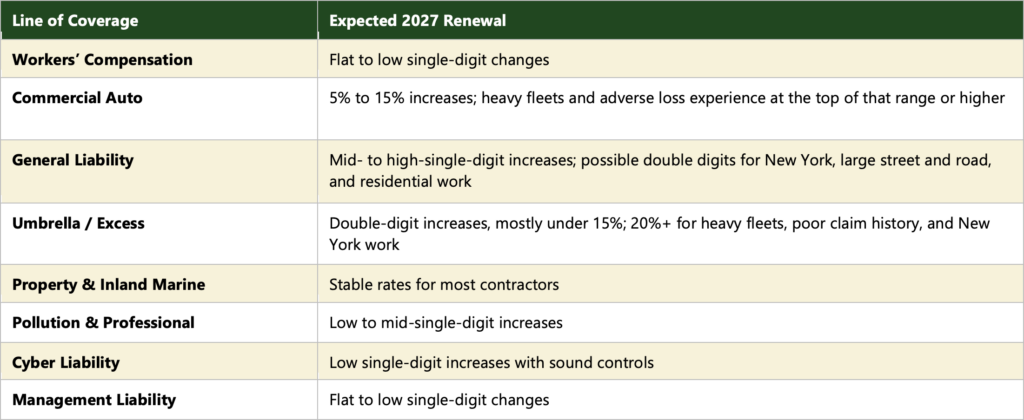
2027 At A Glance
Data Centers and Tariffs
Before getting into the individual lines of coverage, we’ll touch on some trends impacting the industry and how they relate to insurance. Data centers are one of the largest sources of new private construction work in the region, and many contractors will benefit from this work. These projects often come with additional insurance requirements, including higher umbrella limits, owner- or contractor-controlled insurance programs (OCIPs/CCIPs), and stricter indemnity and additional insured language. General contractors on these projects also tend to push liquidated damages and delay exposures down to their trade partners, so contracts must be reviewed closely before signing.
Tariffs on steel, aluminum, and other materials have an insurance impact as well. Higher material costs increase the value of equipment, inventory, and work in place, so builder’s risk and property values set at the start of a project can fall short by the time a loss occurs. Longer lead times can also push project schedules past the original builder’s risk policy term. Contractors should review escalation clauses in their contracts, confirm that builder’s risk policies can be extended or values increased mid-project, and update equipment and property schedules more than once a year. Tariffs on vehicle parts are also adding to auto physical damage costs, which leads to higher insurance premiums.
Workers’ Compensation
Workers’ comp remains the most profitable line of coverage for P&C insurers, posting a 91% combined ratio in 2025 according to NCCI, the twelfth consecutive year below 100%. However, carriers’ margins are starting to tighten as claim costs rise. Construction, the largest industry by workers’ comp premium, has seen claim frequency continue to fall while the cost per claim climbs, driven by rising medical costs and more complex treatment.
For most contractors, we expect flat to low single-digit changes in 2027. That is less relief than many other industries will see, as rising claim severity in construction is limiting further rate reductions for contractors. Increased wages will continue to offset rate decreases, so premiums may not drop even where rates do. Contractors with favorable claim experience should continue to see stable, competitive renewals. Contractors with poor loss experience or increasing experience mods will feel it first if the market begins to turn, and robust return-to-work programs remain one of the most effective ways to control costs.
Commercial Auto
Auto coverage remains one of the more, if not the most, challenging lines across the industry, especially for construction companies with large or heavy fleets. The line has been unprofitable for insurers for more than a decade, and the average commercial auto liability claim has more than doubled in cost over the past nine years. Social inflation, driven by attorney involvement, litigation funding, and jury attitudes toward corporate defendants, continues to drive those costs, along with higher repair costs tied to vehicle technology and tariffs on parts.
There has been some modest relief in the pace of increases. Commercial auto rate increases have slowed in some areas of the market, and many businesses are seeing single-digit rate increases upon renewal. We expect most contractors to see increases in the 5% to 15% range in 2027, with “heavy fleets” and those with adverse loss experience at the top of that range or higher. Telematics, dash cameras, driver training, and clear MVR standards are increasingly expected by underwriters, and these controls will allow contractors to negotiate the most favorable terms.
General Liability
General liability trends continue to mirror the auto market, but increases are not as significant for most businesses. GL rate increases peaked in late 2025 and moderated through 2026. We expect most contractors to see mid- to high-single-digit increases in 2027, with trade contractors the insurance industry views as “low-hazard” at the lower end. Contractors performing work in New York, on large street and road projects, or in residential construction may still face double-digit increases. Underwriters continue to focus on proper risk transfer techniques, such as indemnification language, additional insured endorsements, and certificate of insurance compliance, to ensure they are not taking on unexpected subcontractor risk.
While AI is stealing headlines across most industries, insurance carriers seem to be taking a wait-and-see approach. In January 2026, ISO released a Generative Artificial Intelligence Exclusion (CG 40 47 01 26) that carriers can attach to the CGL policy. It removes coverage for bodily injury, property damage, and personal and advertising injury arising out of generative AI, and carrier filings have spread quickly across nearly every state. However, we are not seeing widespread use of these endorsements yet. As contractors adopt AI tools for estimating, scheduling, safety and design coordination, it will be important to review renewal endorsement schedules carefully and understand where these exclusions may create gaps, including conflicts with the insurance requirements in your contracts.
Umbrella / Excess
The umbrella and excess market remains constrained, especially for high-risk contractors or those with poor claim experience. Nuclear verdicts continue to drive costs across the market. Marathon Strategies reported 190 verdicts of $10 million or more against companies in 2025, a 41% increase over 2024 and the highest total since 2009, with a combined value topping $25.6 billion. Litigation funding continues to receive attention, and eight states enacted tort reform measures in 2025, including damage caps and disclosure requirements for third-party litigation funders. Pennsylvania saw a drop in nuclear verdicts in 2025, which is encouraging, but venue concerns in Philadelphia remain.
Although rate increases moderated somewhat later in 2026, it’s too early to say that the market is softening. We expect most contractors to see double-digit increases in 2027, but most should not exceed 15% unless there are underwriting concerns or poor claim history. Contractors with large or heavy fleets, performing work in New York, and those with poor claim experience could see increases north of 20%. Contractors should be aware of potential capacity reductions on any lead umbrella of $10,000,000 or more, and building an excess tower may require more carriers than in prior years. Unlike most businesses, contractors often can’t reduce limits to manage cost, since owners and general contractors set the requirements in their contracts. Starting excess renewals early and being open to quota share or alternative tower structures will help minimize increases at renewal.
Property & Inland Marine
Property is the most favorable segment in the 2027 market. Commercial property rates have declined over the last year for many businesses, and there is abundant capacity in the market. Strong insurer profitability and lower reinsurance costs are fueling competition. Subject to individual claim experience, we expect stable rates for most contractors in 2027. Other businesses, especially those with large buildings and manufacturing plants, will likely see larger decreases after absorbing much steeper increases over the past several years. Most of a contractor’s property spend is equipment and builder’s risk, which never hardened to the same degree, so there is less room for rates to come down. Competition remains very strong for contractors’ equipment and other inland marine coverages, including builder’s risk, with the continued exception of frame construction.
While rates are coming down for some, construction and reconstruction costs are still rising. Labor costs in particular continue to push reconstruction costs higher. Contractors should continue to confirm that equipment schedules and builder’s risk values reflect current replacement costs.
Data center projects carry very high builder’s risk values, and the owner or general contractor usually controls that coverage. Subcontractors should confirm whether their materials and work in place are covered under the project policy, what the deductible is, who pays it, and whether they need an installation floater on their own program. This could create a coverage gap, where contractors have millions of dollars of work un- or underinsured.
Pollution & Professional
Most contractors now recognize these exposures and carry the coverage, and capacity remains plentiful as carriers continue to compete for the business. We expect low to mid-single-digit increases for most annual programs in 2027, with project-specific placements seeing somewhat more variability. Carriers continue to monitor PFAS, or “forever chemicals,” and design liability trends, particularly as more contractors take on design-build and delegated design responsibilities on large, complex projects like data centers. As with all coverages, results will depend on claim experience. Even those with adverse claim experience will find coverage available in the market, but there may be significant changes to retentions and premiums.
Cyber Liability
Cyber remains a favorable market for buyers, with strong competition, new capacity, and broader coverage options expected to continue into early 2027. Some market observers expect pricing to firm during 2027 as claim activity rises. For contractors, one of the most common losses is payment fraud, where a compromised email account is used to change a subcontractor’s or supplier’s banking information. AI is also making phishing, social engineering, and ransomware attacks more convincing and harder to detect.
We expect low single-digit increases for most contractors with sound controls. Multifactor authentication, endpoint detection and response, and tested backups continue to be best practices that will help secure the most competitive pricing. A thorough, tested Incident Response Plan remains important to maintaining favorable Business Interruption coverage terms. Contractors should also confirm how their policy responds to AI-enabled attacks and fraudulent funds transfer losses.
Management Liability
Primarily comprising Employment Practices, Crime, Fiduciary Liability, and Directors & Officers, these lines are generally a small portion of overall insurance spend for contractors. Crime renewals can be impacted by the level of cyber coverage in place. Clients who cannot obtain sufficient Social Engineering limits under their cyber policy should look to add the coverage to the crime policy, often for a reasonable premium. While wage and hour claims continue to increase in frequency, standalone coverage remains expensive, and most contractors have only a small sublimit for defense costs under their Employment Practices Liability policy. Similar to GL, some carriers have begun adding broad AI exclusions to management and professional liability policies, so reviewing policy language at renewal should continue to be a priority. Abundant capacity and competition among insurers keep pricing stable, with flat to low single-digit changes expected at most 2027 renewals.
What to Do Now
There are a few steps contractors can take now to prepare for their 2027 renewals. Start renewal conversations well before your effective date, especially if you have a large fleet or a lead umbrella of $10,000,000 or more. Large or open claims should come with a short narrative explaining what happened and what has changed since, because without it underwriters tend to price for the worst case. Accurate vehicle schedules, driver lists, MVRs and telematics data also make a real difference in auto and umbrella pricing. Before signing new contracts, especially on data center and other large private projects, compare the insurance requirements, indemnity language and wrap-up terms against your current program. With tariffs and labor pushing costs higher, refresh your equipment, builder’s risk and property values so a loss doesn’t leave you underinsured. Finally, if you have favorable claim experience, it may be worth asking whether a group captive or a different retention strategy could lower your total cost of risk.
Summary
For most contractors, 2027 should be manageable, but the market will continue to look very different from line to line. Modest relief in property, workers’ compensation, and many specialty lines will be offset by continued pressure on auto, umbrella, and excess, and new exclusions tied to emerging technology deserve attention at every renewal. As always, your individual renewal will depend heavily on your loss history, safety programs, fleet exposures, contractual risk transfer, risk profile, and geographic location. We continue to advocate for early engagement, transparency with underwriting partners, and ongoing investment in risk management to smooth the path forward. McConkey’s continued investment in Risk Solutions and Claims Services, as well as appropriately timed marketing of insurance programs and the use of Group Captive programs, continues to help our clients manage their overall insurance spend.
To discuss your insurance program or what to expect at renewal, contact your McConkey consultant or reach out to us.